
The Italian Chapel is the only building that remains of Camp 60, a Prisoner of War (P.O.W.) camp constructed in the latter half of 1941. From January 1942 until the Spring of 1945 the Camp housed Italian POWs of the 6th Anti Aircraft Regiment of the Mantova Division and men from the Italian Tank Corps.
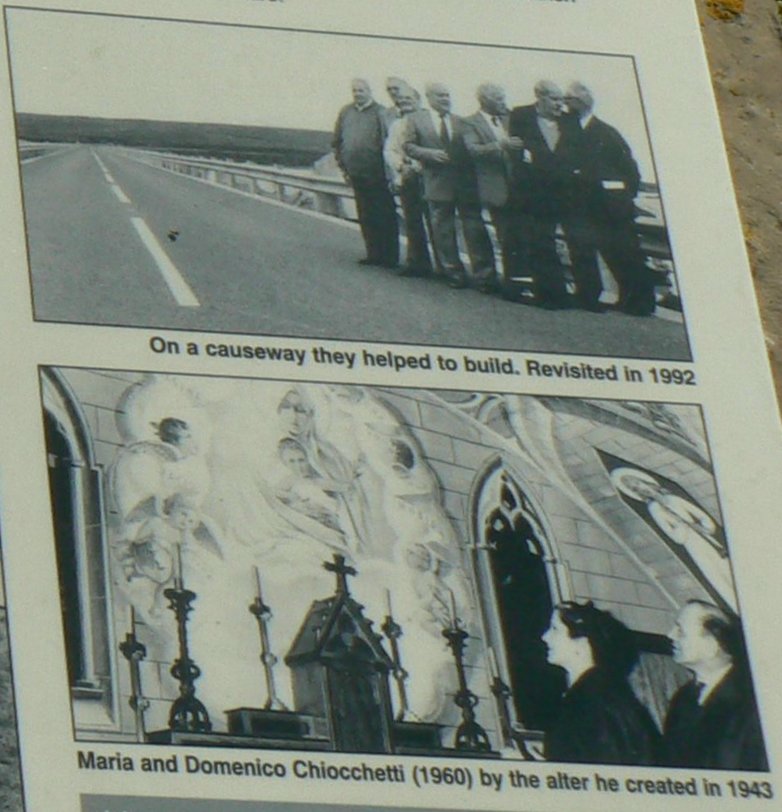
Most of these prisoners, renamed the 5th Italian Labour Battalion, were captured at Tobruk and Benghazi following the North African campaign during World War II. The men were distributed to three P.O.W. camps in Orkney; 500 at Lambholm and a further 700 in two camps in Burray. They were brought in to assist the contractors with the construction of the causeways, later known as the Churchill Barriers, to block off the eastern approaches to Scapa Flow where the British Fleet often lay at anchor.
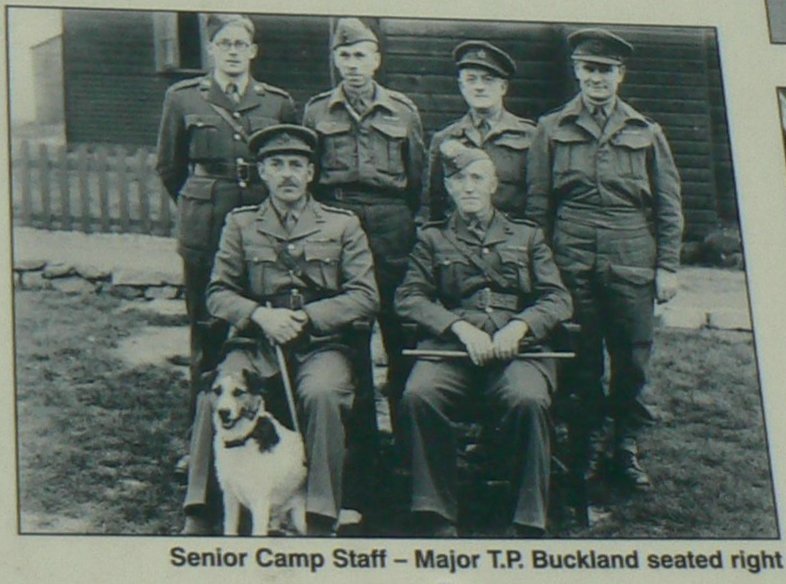
The camp commandant was Major T. P. Buckland assisted by Major G. Fornasier of the Italian Tank Corps. The prisoners worked in the block casting yard, filling gabions with quarried stone and finally laying the asphalt road across the complete causeways.
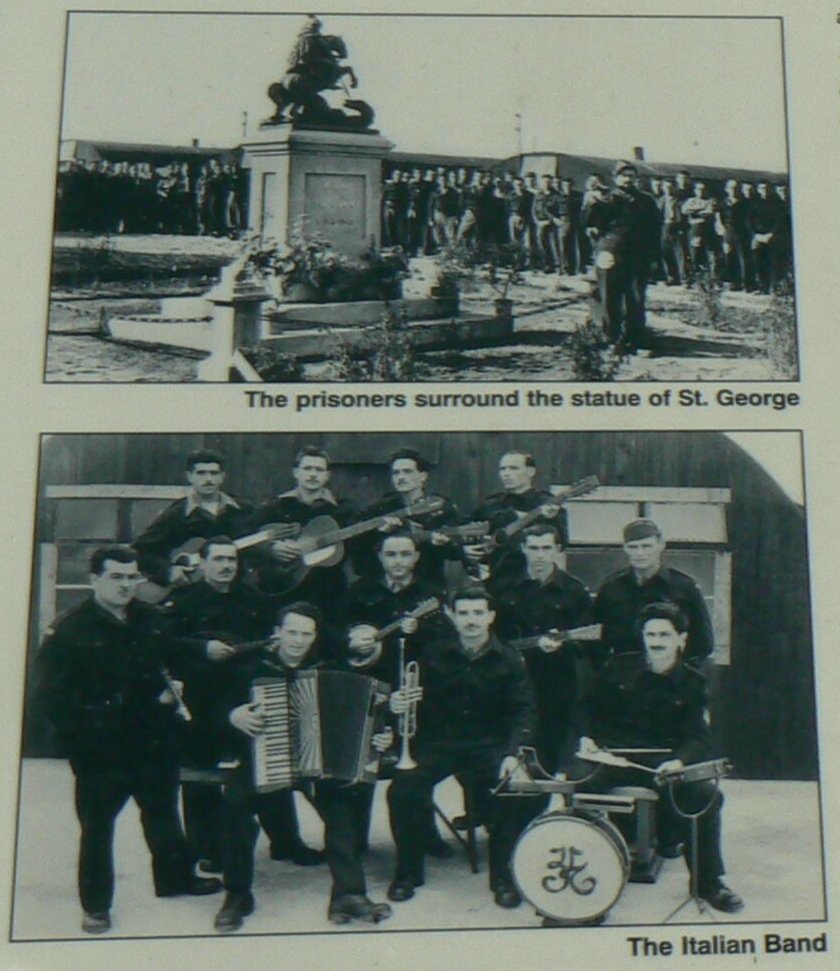
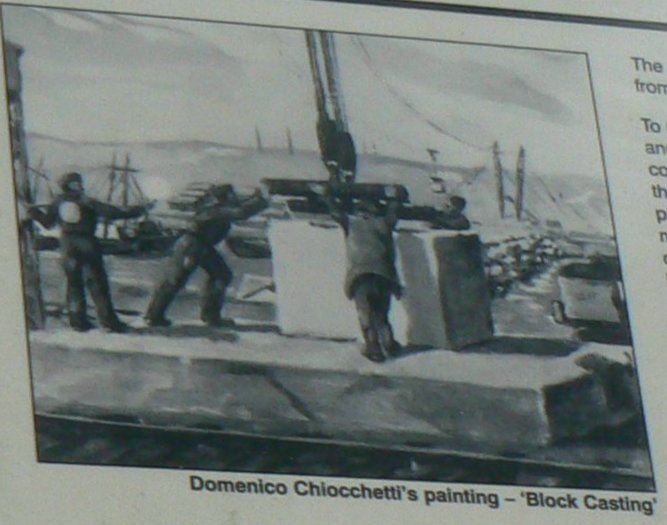
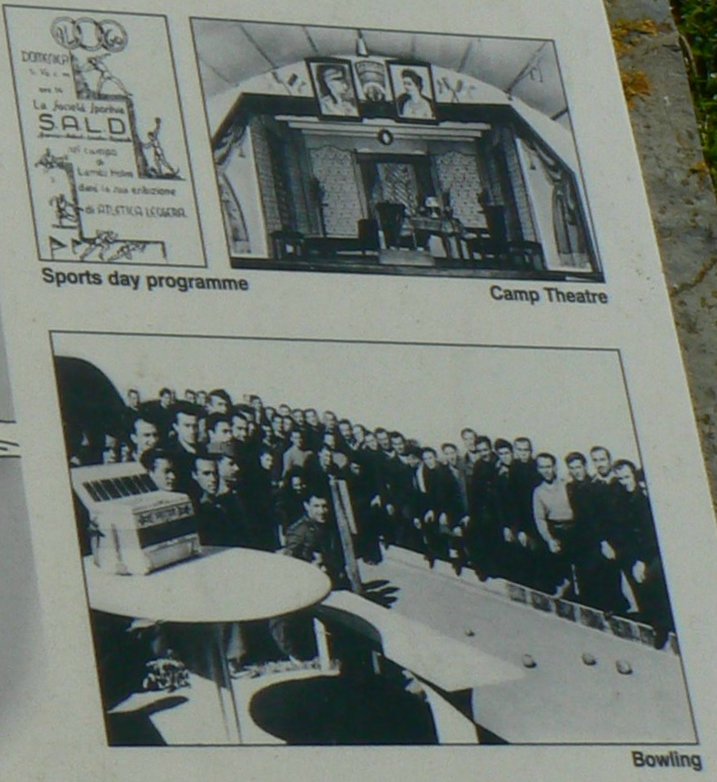
To make the camp more homely the prisoners laid concrete paths and planted flowerbeds outside the huts, the men constructed concrete tables and benches so that they could eat outside when the Orkney weather allowed. To entertain themselves lavish productions such as "The Baker of Venice" were held in a makeshift theatre. They published a newspaper called "Il Corriere delia Domenica" ("The Sunday Courier"), played billiards on a home made concrete table and played bowls.
During the summer the prisoners organised sports competitions against other P.O.W. camps. In their spare time they crafted small trinkets which were sold to local people.
One thing the camp still lacked was a chapel.
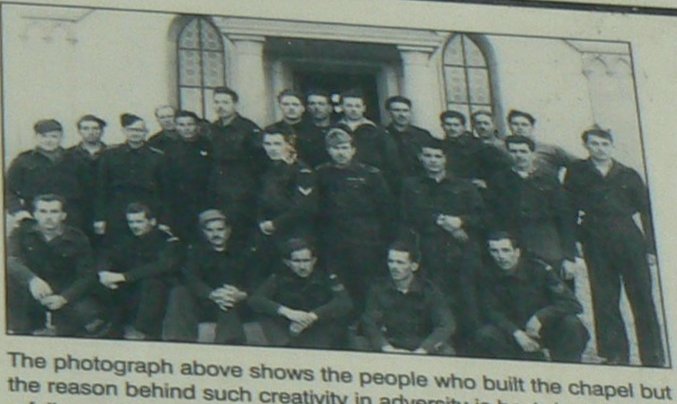
The Italian prisoners in Orkney, thousands of miles from their homeland, deeply felt the need for a place of worship. On September 30th 1943 Padre Gioachino Giacobazzi of the Order of Little Brothers arrived at the camp and through his enthusiastic efforts and the help of Major Buckland, the camp commandant, two Nissen huts were make available to the prisoners. They were placed end to end and were originally intended to serve as a school and a church. Domenico Chioccetti, an artist, had originally constructed a concrete statue of St. George Slaying the Dragon which presided over the camp "square". He gathered together a team of craftsmen and began work on a sanctuary.
As Chiocchetti worked, the imagination needed to transform the drab huts into a magnificent place of worship inspired his fellow Italians. As one area of the hut was completed, the need to design further works of art became necessary. Complete sections made the rest of the hut uninviting and the workers decided to beautify the whole interior.
All of the work was accomplished under Chiocchetti's supervision. Besides undertaking the pictorial and decorative work he also designed the altar, tabernacle, candlesticks, lamps, roodscreen, windows and coloured glass, and all the details of the ornamental material -- mostly scrap, wood from a wrecked ship and concrete sculpted with loving skill and care. Above the altar is Chiocchetti's masterpiece. It is based on Nicolo Barabino's Madonna of the Olives from a small picture given by his mother to Domenico which he carried with him throughout the war.
The chapel was in use for only a very short time. In May 1945, before it was completely finished, the prisoners were moved to Skipton in Yorkshire, for repatriation. Chioccetti stayed behind to finish the font on which he was working.
A promise that Orcadians would cherish their chapel was given to the prisoners by Mr. P. N. Sutherland Graeme, Lord Lieutenant of Orkney, who was the owner of the island, and who had taken much interest in their welfare.
"It was the wish to show to oneself first, and to the world then, that in spite of being trapped in a barbed wire camp, down in spirit, physically and morally deprived of many things, one could still find something inside that could be set free ...
"The statue of St. George was built first. It shows the patron saint of the soldiers ready to kill the dragon.
"... It is the symbol of a will to 'kill' all misunderstandings among people of different cultures. As the St. George was built to express the physical and psychological pain, so was the chapel conceived to meet a spiritual need."